Frozen Shoulder?
Let’s Find Out Why.
Frozen shoulder can make simple things surprisingly difficult—reaching overhead, fastening clothing, putting on a jacket, grooming your hair, or sleeping comfortably.
Dr. Richard Collin evaluates painful, stiff shoulders in Buford, GA to help determine whether the pattern fits frozen shoulder (adhesive capsulitis), another shoulder condition, or something that needs imaging or referral.

Does This Sound Like You?

Frozen shoulder often becomes noticeable during ordinary movements that used to be easy.
More frozen-shoulder symptoms
What Is Frozen Shoulder?
Frozen shoulder, also called adhesive capsulitis, involves pain and progressive loss of shoulder motion as the capsule surrounding the joint becomes inflamed, thickened, and tight.
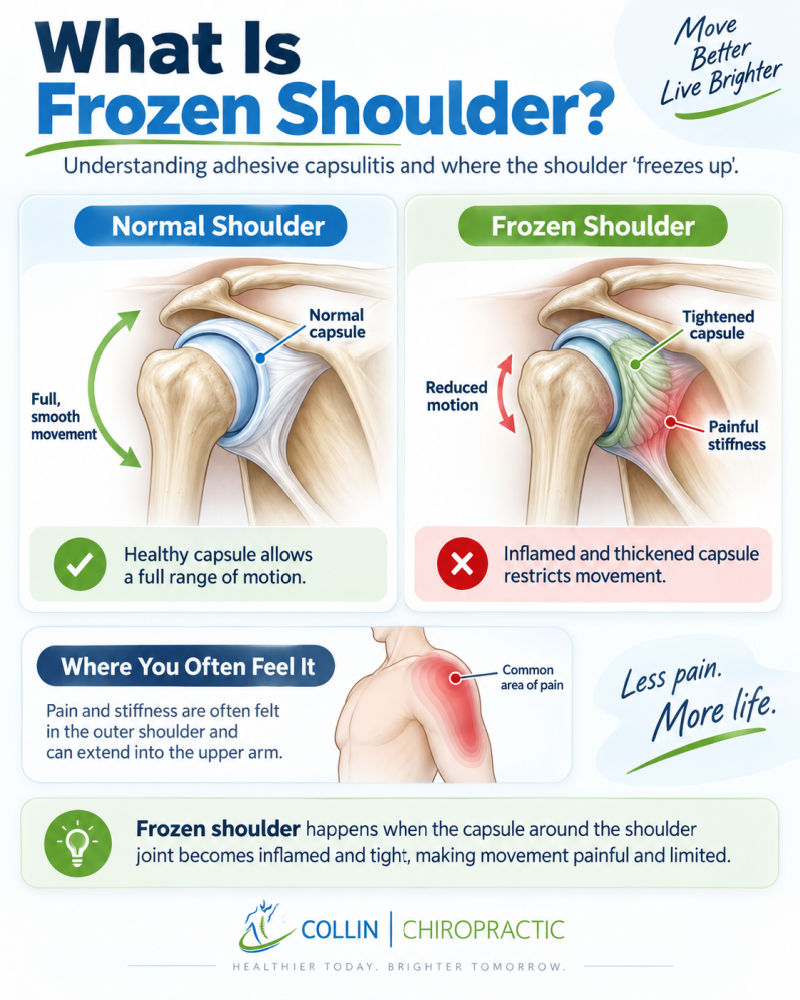
Normal Shoulder
A flexible shoulder capsule allows the humeral head to move freely within the socket.
Frozen Shoulder
The capsule becomes inflamed, thickened, and tight, reducing the room available for comfortable movement.
Where Pain Is Often Felt
People commonly describe pain around the outer shoulder or upper arm, although the exact pattern can vary.
The 4 Stages of Frozen Shoulder
Some clinical classifications separate the earliest painful period from the later freezing phase. In that four-stage framework, symptoms progress through pre-freezing, freezing, frozen, and thawing.
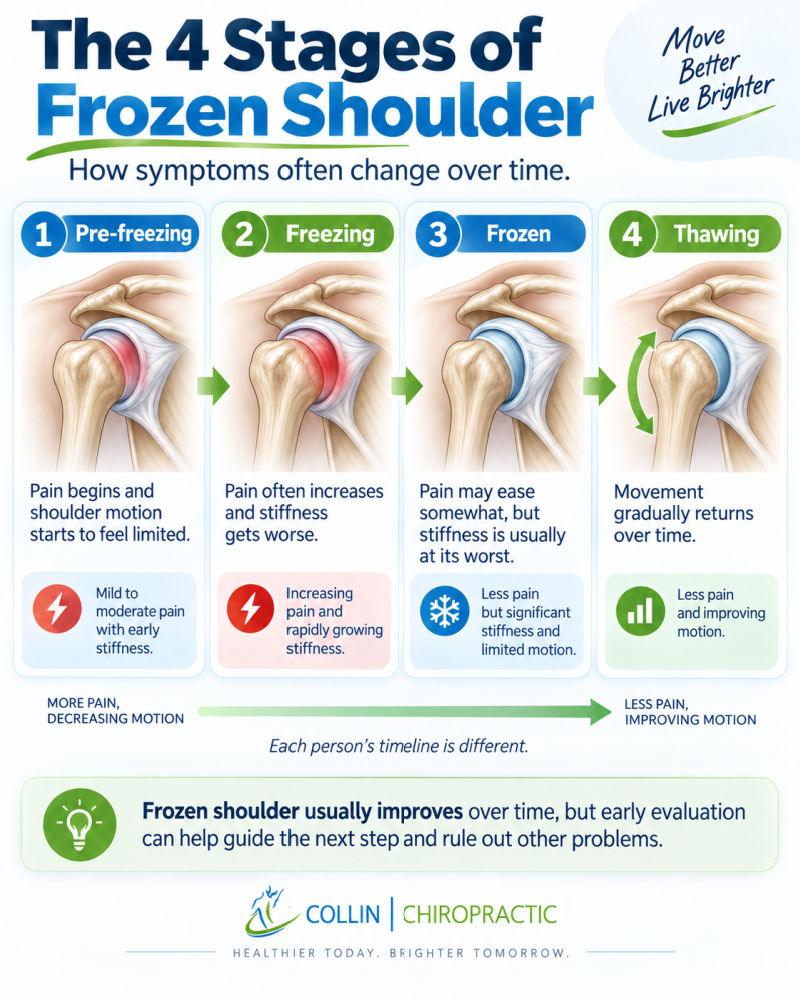
Pre-Freezing
Pain begins and mild stiffness may appear, while motion can still be relatively preserved.
Freezing
Pain often increases while the shoulder becomes progressively harder to move.
Frozen
Pain may ease somewhat, but stiffness and loss of motion are often most noticeable.
Thawing
Shoulder motion gradually begins to return, although recovery can take time.
You may also see frozen shoulder described in three broader phases—freezing, frozen, and thawing. The four-stage model simply separates the earliest painful period as “pre-freezing.”
How Dr. Collin Evaluates Frozen Shoulder
The goal is to determine whether the loss of motion fits adhesive capsulitis or whether another shoulder, neck, or neurological problem may be contributing.

What the evaluation may include
Our Approach to Frozen Shoulder
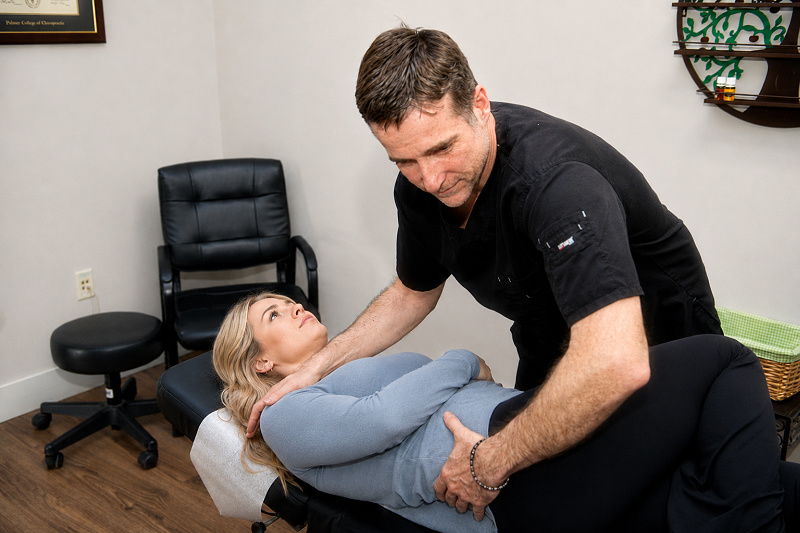
Hands-on care may be adapted to the shoulder’s current pain level, motion, and stage of recovery.
Frozen shoulder is not treated by simply forcing the joint farther. Care should match the individual findings and how irritable or restricted the shoulder is at that point in time.
More about our approach
When appropriate, care may include gentle shoulder or extremity adjusting, soft-tissue work, mobility guidance, upper-back or shoulder-blade support, and home exercises. If significant weakness, trauma, suspected tear, arthritis, or another medical problem is more likely, Dr. Collin can recommend imaging or referral instead.

Helpful Things to Notice at Home
Notice Which Motions Are Disappearing
Pay attention to reaching overhead, behind your back, across your body, and outward rotation. Progressive restriction in several directions is an important clue.
Track Night Pain and Sleep
Night pain and difficulty sleeping on the affected side are common details worth mentioning during an evaluation.
Remember What Happened Before the Stiffness
Tell Dr. Collin if the shoulder became less active after an injury, surgery, illness, or another period when you were not using the arm normally.
When Shoulder Symptoms May Need Medical Evaluation
Seek prompt medical evaluation after significant trauma, with obvious deformity, sudden major weakness, loss of sensation, fever with a hot red swollen joint, or severe unexplained shoulder pain. These patterns are not typical of uncomplicated frozen shoulder.
Related Conditions & Care
Frozen shoulder can overlap with other shoulder, neck, nerve, or injury-related complaints.
New to the office? View New Patient Information
Frozen Shoulder FAQ
Where exactly does a frozen shoulder hurt?
Pain is often felt around the outer or front shoulder and may extend into the upper arm. Night pain and discomfort when reaching are also common.
What should you not do with frozen shoulder?
Avoid repeatedly forcing the shoulder through sharp pain or aggressively stretching simply to “break” the stiffness. The amount and intensity of movement should fit the shoulder’s current stage and irritability.
What gets mistaken for frozen shoulder?
Rotator cuff problems, bursitis, arthritis, impingement-type pain, neck-related pain, and other shoulder conditions can look similar early on. Examination helps distinguish the patterns.
What’s the fastest way to heal a frozen shoulder?
There is usually no instant fix. Frozen shoulder often improves gradually over time. Appropriate evaluation, stage-matched movement, symptom management, and referral when needed can help guide recovery without unnecessarily aggravating the shoulder.
Why does frozen shoulder happen?
Sometimes there is no clear trigger. Frozen shoulder can also develop after surgery, injury, or another period when the shoulder has been kept relatively still, and it is more common in people with certain medical conditions such as diabetes.
Do I need X-rays or an MRI for frozen shoulder?
Not everyone does. Imaging may be useful when the history or examination suggests arthritis, fracture, rotator cuff injury, or another condition that needs to be ruled out.
Can frozen shoulder get better on its own?
Frozen shoulder often improves over time, but the process can be slow. An evaluation can help confirm the pattern, rule out other causes, and guide appropriate movement or referral during recovery.
Shoulder Getting Stiffer?
If shoulder pain and loss of motion are interfering with sleep, dressing, work, or everyday movement, Dr. Collin will listen, evaluate the shoulder, and explain the next step.
Location & Contact
4965 Lanier Islands Pky,
Suite 103
Buford, Georgia 30518
Call Today: 770-361-8225



Hours
Tues: 9 am - 1 pm
Saturday: 9 am - 12 pm
Call Today: 770-361-8225

"AWESOME, AWESOME, AWESOME! A for-sure place you want to check out for all your Chiropractic and Wellness needs. Would refer time and time again."
~Ashlea
Join us on Social for announcements, deals, health tips and latest products!
 |
 |