Numbness or Tingling?
Let’s Find Out Why.
Numbness, tingling, burning, or pins-and-needles sensations can feel unsettling—especially when they affect your hands, fingers, feet, or toes.
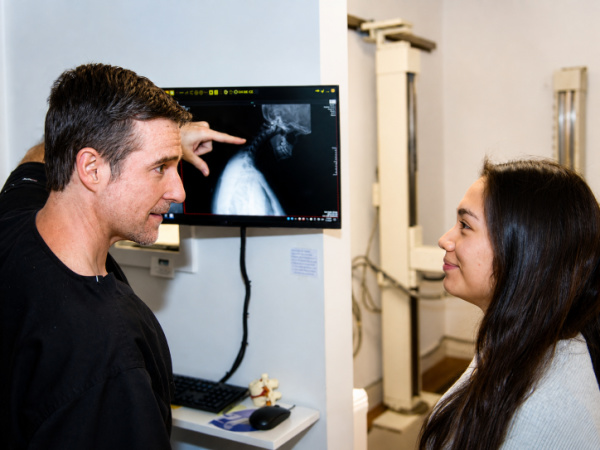
Dr. Richard Collin takes time to identify where symptoms begin and travel, evaluate whether the pattern may involve the neck, lower back, discs, joints, muscles, or nearby nerves, and explain the next step.
Does This Sound Like You?
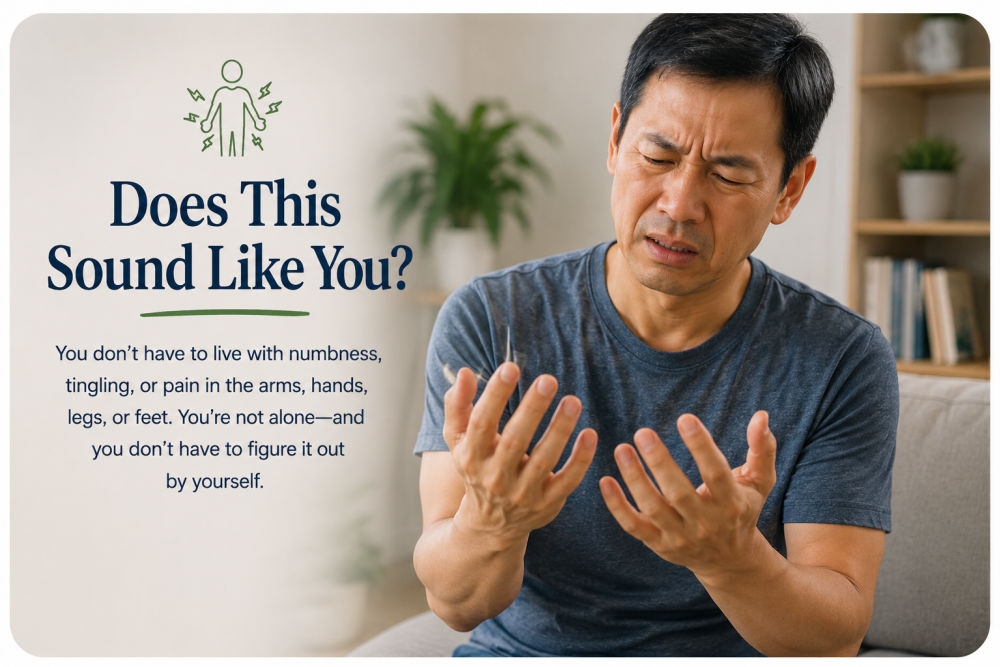
The location, pattern, and timing of these sensations can provide useful clues. See if any of these feel familiar.
More numbness and tingling symptoms
Worried About Numbness or Tingling?
Persistent, recurring, or worsening numbness, tingling, burning, radiating pain, or weakness should be evaluated rather than assumed to be a simple “pinched nerve.” Same-day appointments are often available, and walk-ins are welcome.
Call 770-361-8225What Can Cause Numbness and Tingling?
These symptoms can have many possible causes. An evaluation helps determine whether the pattern appears musculoskeletal, nerve-related, or better addressed by another healthcare provider.
Cervical Nerve Irritation
Irritation involving a cervical nerve root may contribute to upper-extremity symptoms such as radiating arm pain, tingling, numbness, sensory changes, or weakness.
Lumbar or Sciatic Irritation
Lumbar nerve-root or sciatic irritation may contribute to lower-extremity symptoms traveling into the hip, leg, foot, or toes.
Disc-Related Problems
A cervical or lumbar disc bulge, protrusion, or herniation may irritate or compress a nearby nerve root and create radicular symptoms.
Joint, Muscle & Soft-Tissue Irritation
Joint restriction, muscle tension, inflammation, or irritated soft tissues may affect nearby structures or change how an area moves.
Posture & Repetitive Activity
Desk work, driving, repeated tool use, exercise, or sleeping positions may aggravate symptoms in some people.
Injury or Another Medical Cause
Falls, sports injuries, and car accidents may affect joints, discs, muscles, or nerves. Circulation problems, peripheral nerve disorders, and other medical conditions can also cause numbness or tingling and may require medical evaluation.
What Does “Pinched Nerve” Mean?
People often use the phrase “pinched nerve” to describe pain, numbness, tingling, burning, or weakness that travels into an arm or leg. Sometimes a nerve is compressed or irritated. In other cases, inflammation, a disc problem, joint restriction, muscle tension, or another condition may be contributing.
Not every tingling sensation means a nerve is literally trapped or pinched. The symptom pattern matters more than the label.
How Dr. Collin Evaluates Nerve Symptoms
The first step is understanding where symptoms begin, where they travel, whether weakness or sensory changes are present, and what else may be contributing.

What the evaluation may include
Our Approach to Numbness, Tingling & Nerve Symptoms
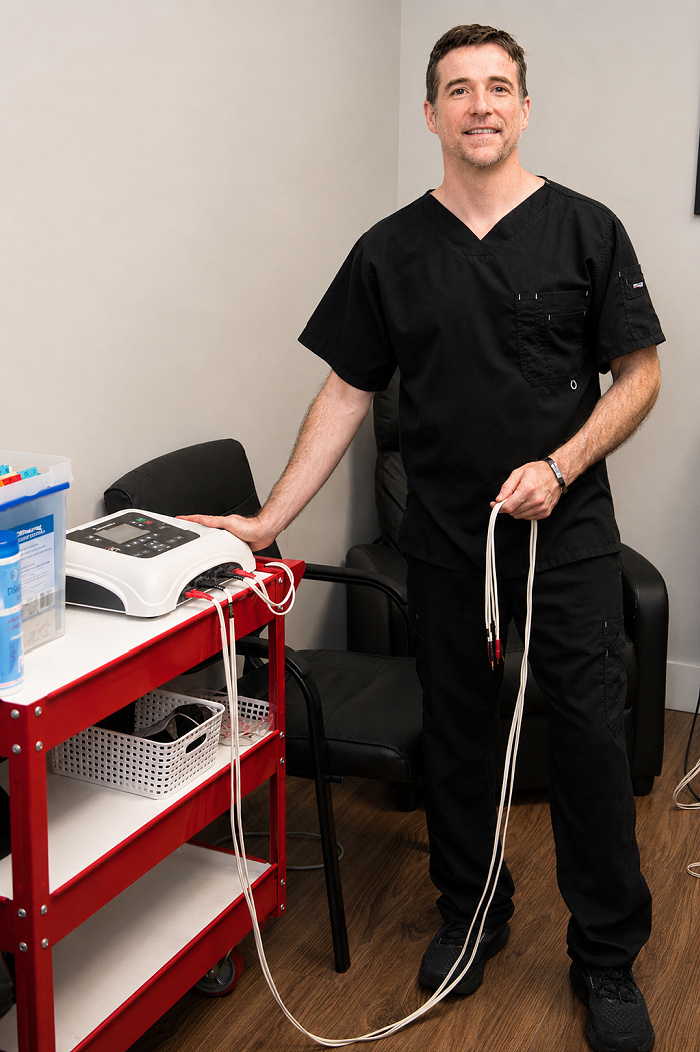
Supportive therapies such as electrical stimulation may be used when appropriate as part of an individualized care plan.
Care depends on what appears to be causing the symptoms. Chiropractic care is not the right answer for every case, and the goal is not simply to label every sensation a “pinched nerve.”
More about our approach
When findings suggest a musculoskeletal or nerve-related pattern, care may include chiropractic adjustments, soft-tissue care, posture guidance, stretching, home exercises, activity changes, or supportive therapies. If the pattern suggests cervical radicular symptoms, lumbar radicular symptoms, significant weakness, progressive sensory loss, nerve-root compression, a disc injury, peripheral nerve involvement, or another medical condition, Dr. Collin can explain whether imaging, referral, or coordinated medical care may be appropriate.

What to Do While You’re Monitoring Nerve Symptoms
Notice Where Symptoms Travel
Make note of where numbness, tingling, burning, or radiating pain begins and where it travels. That pattern can be useful during an evaluation.
Change Positions When Practical
If a position consistently aggravates symptoms, avoid staying there for long periods. Gentle position changes may help while you are determining what is contributing.
Don’t Push Through Weakness
Increasing weakness, loss of grip, foot drop, worsening numbness, or symptoms traveling farther into an arm or leg deserve prompt evaluation rather than being pushed through during exercise or work.
When Is It an Emergency?
Seek emergency medical care for sudden numbness or weakness with facial drooping, trouble speaking, confusion, severe headache, chest pain, difficulty walking, loss of coordination, bowel or bladder changes, saddle-area numbness, or symptoms after serious trauma.
Related Conditions We Treat
Numbness and tingling may overlap with neck, back, disc, sciatic, whiplash, or other injury-related symptoms.
Looking for a broader overview? View Chiropractic Services · Personal Injury Care
Numbness, Tingling & Pinched Nerve FAQ
Can a chiropractor help with numbness and tingling?
Chiropractic care may be appropriate when symptoms appear related to certain musculoskeletal or nerve-related patterns. Dr. Collin evaluates the symptoms first and explains whether chiropractic care makes sense or whether another type of evaluation is needed.
Does tingling always mean I have a pinched nerve?
No. “Pinched nerve” is a common phrase, but tingling can have many possible causes, including nerve irritation or compression, disc problems, inflammation, muscle tension, circulation issues, peripheral nerve conditions, or other medical causes.
What are cervical or lumbar radicular symptoms?
Radicular symptoms are pain, tingling, numbness, or sometimes weakness that follows a pattern related to irritation of a cervical or lumbar nerve root. When nerve-root dysfunction is confirmed, clinicians may use terms such as cervical radiculopathy or lumbar radiculopathy.
What does paresthesia mean?
Paresthesia is a clinical term for abnormal sensations such as tingling, pins-and-needles, prickling, burning, or “buzzing.” Paresthesia describes the sensation; it does not by itself identify the cause.
Can neck problems cause numbness in my hands or fingers?
They can in some cases. Cervical nerve-root irritation may contribute to upper-extremity symptoms traveling into the shoulder, arm, hand, or fingers. A careful evaluation helps determine whether the pattern appears related to the neck or another source.
Can lower-back problems cause tingling in my feet or toes?
Yes. Lumbar nerve-root or sciatic irritation may contribute to lower-extremity symptoms traveling into the hip, leg, foot, or toes. Foot and toe symptoms can also have other causes, so evaluation is important.
When should numbness or tingling be treated as an emergency?
Seek emergency care for sudden symptoms accompanied by facial drooping, trouble speaking, confusion, severe headache, chest pain, difficulty walking, loss of coordination, significant weakness, bowel or bladder changes, saddle-area numbness, or symptoms after serious trauma.
Let’s Help You Understand What’s Going On.
If numbness, tingling, burning, radiating pain, or weakness is affecting your comfort or daily life, Dr. Collin will take time to listen, evaluate the pattern, and explain the next step.
Location & Contact
4965 Lanier Islands Pky,
Suite 103
Buford, Georgia 30518
Call Today: 770-361-8225



Hours
Tues: 9 am - 1 pm
Saturday: 9 am - 12 pm
Call Today: 770-361-8225

"AWESOME, AWESOME, AWESOME! A for-sure place you want to check out for all your Chiropractic and Wellness needs. Would refer time and time again."
~Ashlea
Join us on Social for announcements, deals, health tips and latest products!
 |
 |